MCP Studio
- Year
- 2026
- Role
- Design and engineering
- Status
- In progress
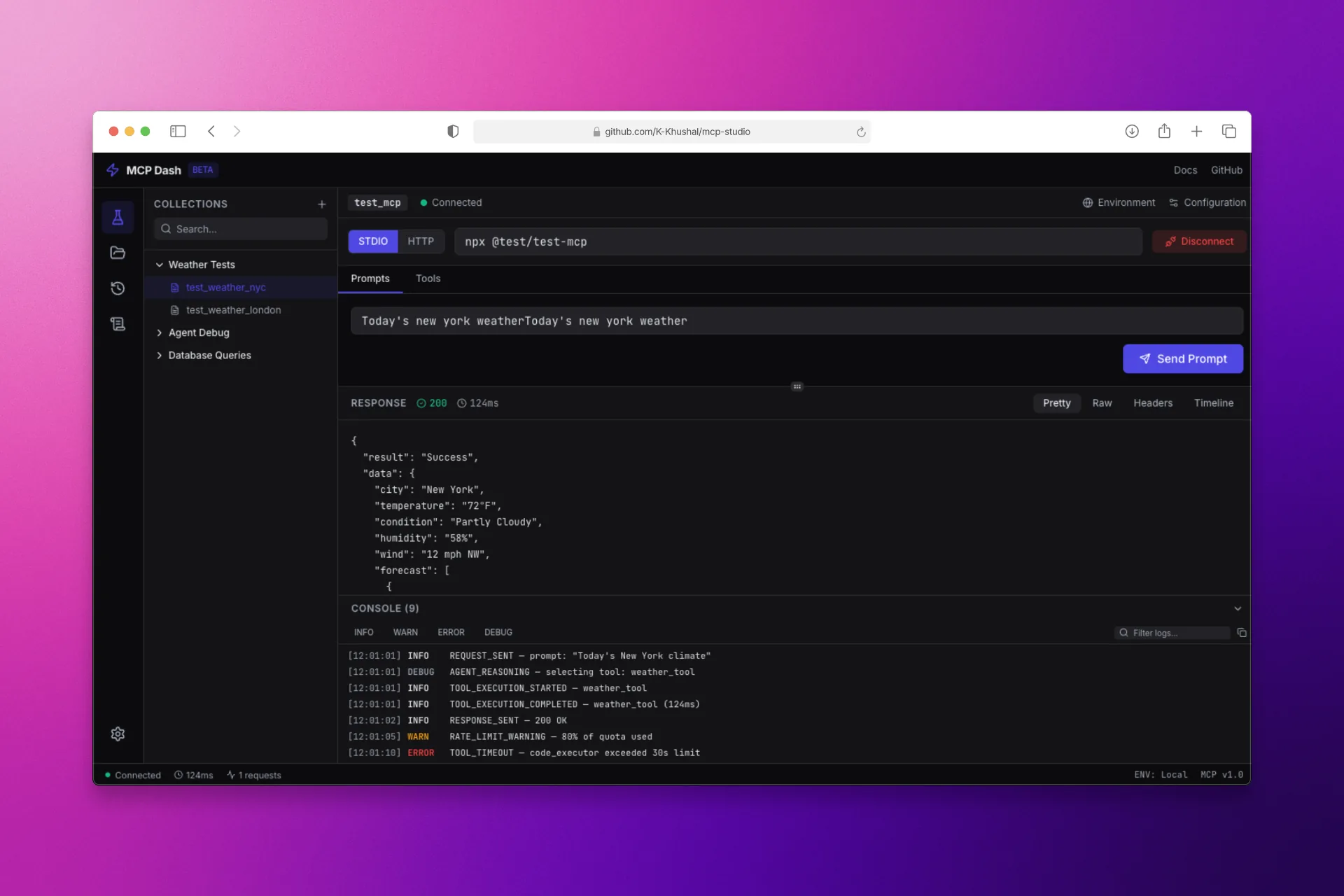
See what a tool call does
MCP Studio is a local workbench for testing MCP servers. I built schema-driven tool forms, raw JSON input, response inspection and protocol logs, with saved collections and environments for repeatable requests.
The React interface communicates with a Bun backend. The backend owns MCP connections and local subprocesses; SQLite stores collections and environments.
How it works
The browser uses the studio’s WebSocket protocol. MCP communication starts at the backend.

Bun backend
Each WebSocket session gets a SessionManager. The Bun backend owns connection state, MCP clients and local subprocesses.
All implementation notes
Connections
- React workbench
- JSON schemas drive tool forms, with raw JSON available for unsupported shapes. The frontend sends typed commands through the studio WebSocket protocol.
- Bun backend
- Each WebSocket session gets a SessionManager. The Bun backend owns connection state, MCP clients and local subprocesses.
- Local MCP server
- The stdio adapter starts a process with its command, arguments, working directory and environment. Local execution requires the backend on that machine.
- Remote MCP server
- The Streamable HTTP adapter connects through the MCP SDK. Both adapters expose the same tool-listing and invocation interface.
- Local SQLite
- Drizzle persists collections and environments in local SQLite. Startup runs migrations and enables foreign keys; live connection state remains separate.
- React workbench: sends typed commands over WebSocket (Bun backend).
- Bun backend: starts and communicates with a local process (Local MCP server).
- Bun backend: connects through the MCP SDK (Remote MCP server).
- Bun backend: persists collections and environments (Local SQLite).
Engineering decisions
- Two transports, one interface. Separate stdio and Streamable HTTP adapters expose the same tool operations. Each WebSocket session has its own connection manager.
- Configuration stays inspectable. Environment interpolation handles nested request values and reports missing variables instead of silently replacing them with empty strings.
- Persistent requests are separate from live sessions. Drizzle migrations run at SQLite startup. Tests cover persistence and frontend stores; connection state remains transient.
Turborepo coordinates the apps and shared packages. Automated result assertions and a desktop wrapper remain roadmap items.