GoMobility
- Year
- 2026
- Role
- Design and engineering
- Status
- Live
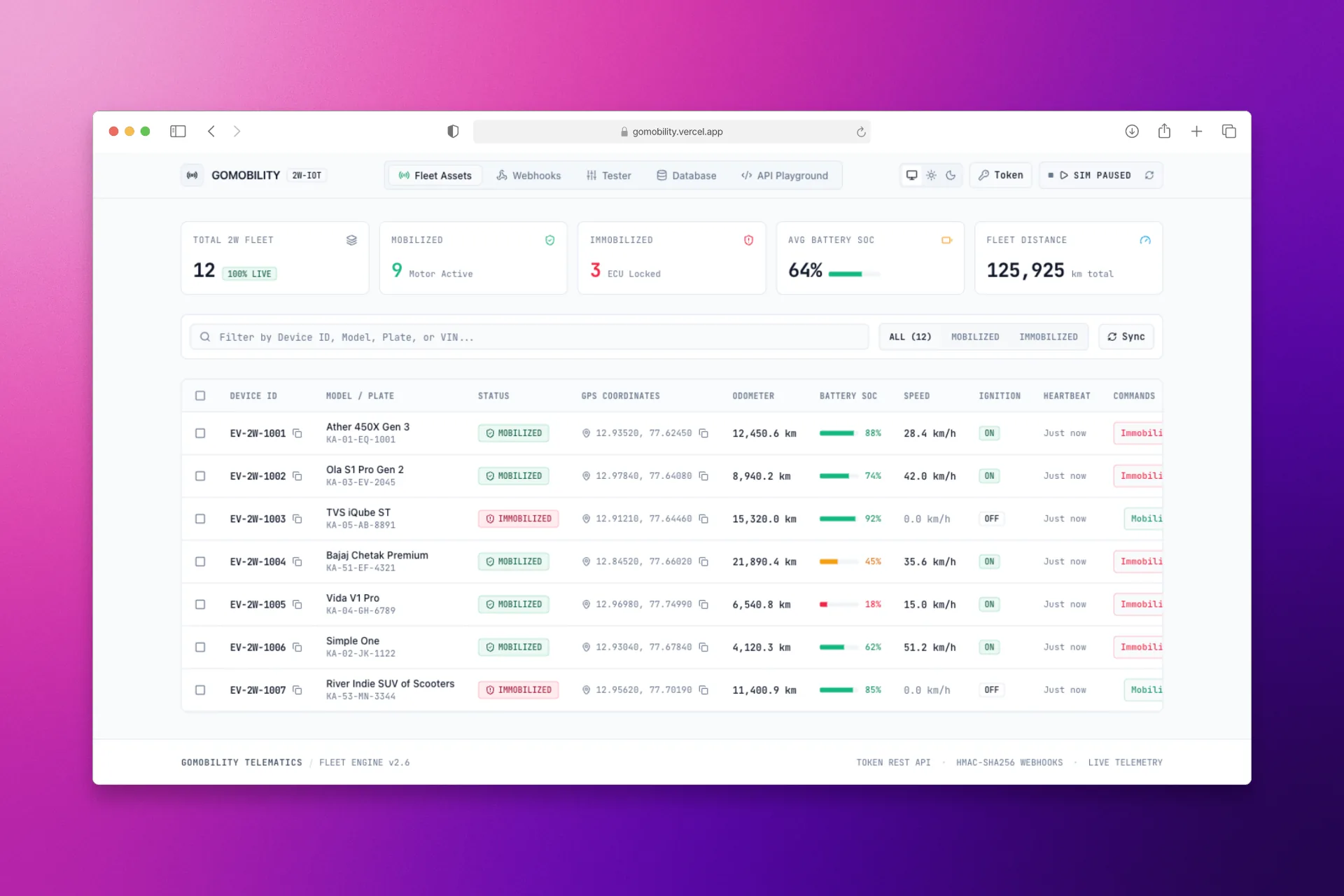
A fleet you can inspect
GoMobility is a fleet dashboard and API playground for electric two-wheelers. I built vehicle search, telemetry views, mobilize and immobilize commands, command history and a webhook tester.
Seeded vehicles move along simulated Bengaluru routes. The demo shows changing telemetry without claiming a connection to physical vehicles.
How it works
The dashboard polls every three seconds. API routes delegate to services for vehicle state, commands and delivery logs.
REST API
Route handlers delegate to services for assets, telemetry and commands. Bearer tokens protect the API flow used by the endpoint playground.
All implementation notes
Fleet system
- Fleet dashboard
- The dashboard polls every three seconds and supports individual or bulk vehicle commands. The fleet is seeded demo data, not connected physical vehicles.
- REST API
- Route handlers delegate to services for assets, telemetry and commands. Bearer tokens protect the API flow used by the endpoint playground.
- SQLite
- SQLite enables foreign keys and write-ahead logging. Hosted demo storage is temporary; it does not promise durable fleet state.
- IoT simulator
- The simulator updates seeded vehicles along Bengaluru waypoints. Telemetry ingestion is a separate API path for submitting readings.
- Webhook receiver
- The webhook service signs serialized payloads with HMAC-SHA256, times out after six seconds and records status, duration and a bounded response excerpt.
- Fleet dashboard: polls assets and sends commands (REST API).
- REST API: reads and updates vehicle state (SQLite).
- IoT simulator: generates telemetry updates (SQLite).
- REST API: dispatches signed events (Webhook receiver).
Engineering decisions
- Make commands traceable. Individual and bulk commands update vehicle state and retain history. The playground uses the same API payloads as the interface.
- Make delivery failures visible. Webhooks use HMAC-SHA256 signatures and a six-second timeout. Logs record status, duration, errors and a bounded response excerpt.
- Keep the demo boundary explicit. SQLite enables foreign keys and write-ahead logging, but hosted storage is temporary. Durable persistence, a background queue and production retries would be separate work.